Artists have used facial proportions for centuries to draw believable faces, and beauty guides often quote them as "ideal" measurements. Some of these rules are useful for understanding why certain hairstyles, brows or beards balance a face; others are more myth than science. This guide explains the golden ratio face, facial thirds and fifths, how to measure yourself, and how much any of it really matters.
The golden ratio face
The golden ratio (φ, about 1.618) is a number that appears in mathematics and is often linked to beauty in art and design. Applied to faces, the idea is that certain lengths divided by others should equal roughly 1.618. Commonly quoted examples:
- Face length ÷ face width ≈ 1.618
- Mouth width ÷ nose width ≈ 1.618
- Distance from the hairline to the eyes ÷ distance from the eyes to the chin close to the golden ratio in some descriptions
What the research says
Studies that tested the golden ratio directly have found that faces people rate as attractive do not consistently match 1.618. Some research suggests other ratios, such as the distance between the eyes relative to face width, matter more, and that averageness (being close to the average of many faces) and symmetry are stronger predictors. The golden ratio is best treated as an interesting reference, not a beauty standard.
You can measure your own ratios from a photo with the golden ratio face calculator.
The rule of facial thirds
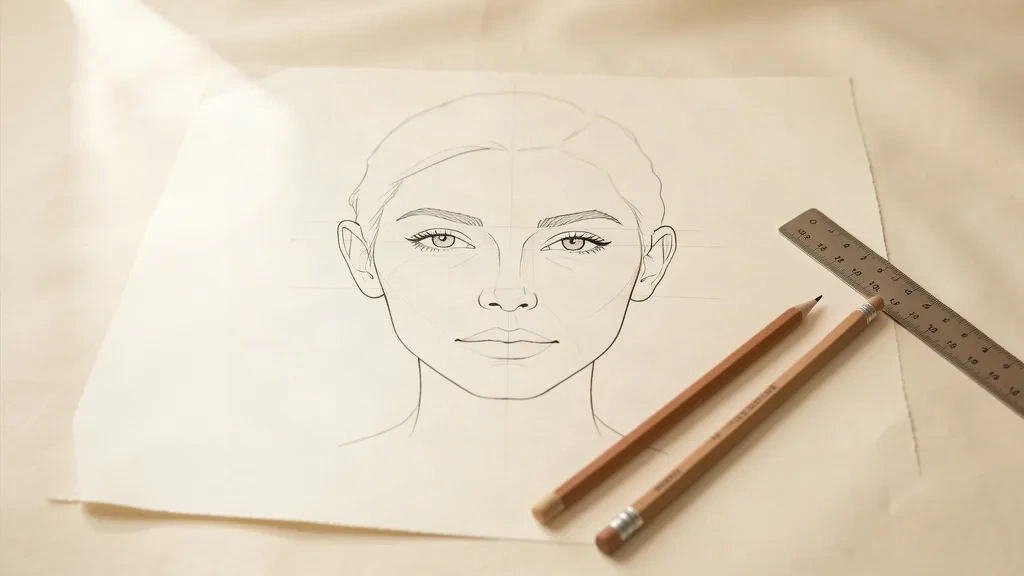
The face is divided horizontally into three sections:
- Upper third: hairline to the brows.
- Middle third: brows to the base of the nose.
- Lower third: base of the nose to the bottom of the chin.
In classical proportion guides, the three sections are roughly equal. Within the lower third, the upper lip often takes about one third and the lower lip and chin about two thirds.
Why it's useful
- A longer upper third (tall forehead) can be balanced with bangs.
- A longer lower third can be balanced with fuller hair at the sides or a beard kept shorter at the chin.
- A shorter lower third can be lengthened with a goatee or chin-focused beard.
The rule of facial fifths
The face is divided vertically into five sections, each roughly one eye width wide:
- Outer edge of the face to the outer corner of the right eye.
- Width of the right eye.
- Space between the eyes (often about one eye width).
- Width of the left eye.
- Outer corner of the left eye to the outer edge of the face.
This is a classic drawing guide. Real faces vary a lot, and wide-set or close-set eyes are simply variations, not flaws.
How to measure your facial proportions
- Take a straight-on photo at eye level, from at least arm's length, with a neutral expression and hair pulled back.
- Mark the hairline, brows, nose base, chin, and the corners of the eyes and mouth.
- Measure the three vertical sections and the five horizontal sections.
- Compare face length to width at the cheekbones.
Or upload a photo to the golden ratio face calculator or the attractiveness test, which measure these points automatically and show them on your photo.
Do proportions really matter?
They matter for styling: knowing that your forehead is tall or your lower face is short helps you choose bangs, part lines, glasses and beard shapes. They matter much less for attractiveness, which research links to a mix of averageness, symmetry, skin, expression, grooming and personal and cultural preferences. Small differences of a few millimeters are invisible in everyday life.
Using proportions to choose a style
- Tall upper third: bangs or a side fringe; avoid lots of height on top.
- Long lower third: fuller sides, shorter chin beard, flatter brows.
- Wide face (fifths wider at the edges): height on top, face-framing layers, angular glasses.
- Narrow face: volume at the sides, rounder glasses.
Find your overall face shape with the face shape detector and read the face shapes guide.
FAQ
What is the golden ratio of the face?
It's the idea that certain facial measurements, such as face length divided by width, should equal about 1.618. Research has not shown that matching this number makes a face more attractive.
What are facial thirds?
The face divided horizontally into three sections: hairline to brows, brows to the base of the nose, and nose to chin. Classical proportions describe them as roughly equal.
How do I calculate my face's golden ratio?
Measure your face length (hairline to chin) and width (at the cheekbones) from a straight-on photo and divide length by width. A golden ratio face calculator can do this from a photo.
What are ideal facial proportions?
There is no single ideal. Classical guides use equal thirds and fifths, but real attractive faces vary widely.
Can you change your facial proportions?
Bone proportions don't change, but hairstyles, brows, glasses and facial hair can change how your proportions are perceived.